
Journal / Supplements & Performance
Collagen for Active Women: What the Research Actually Says
6 min read
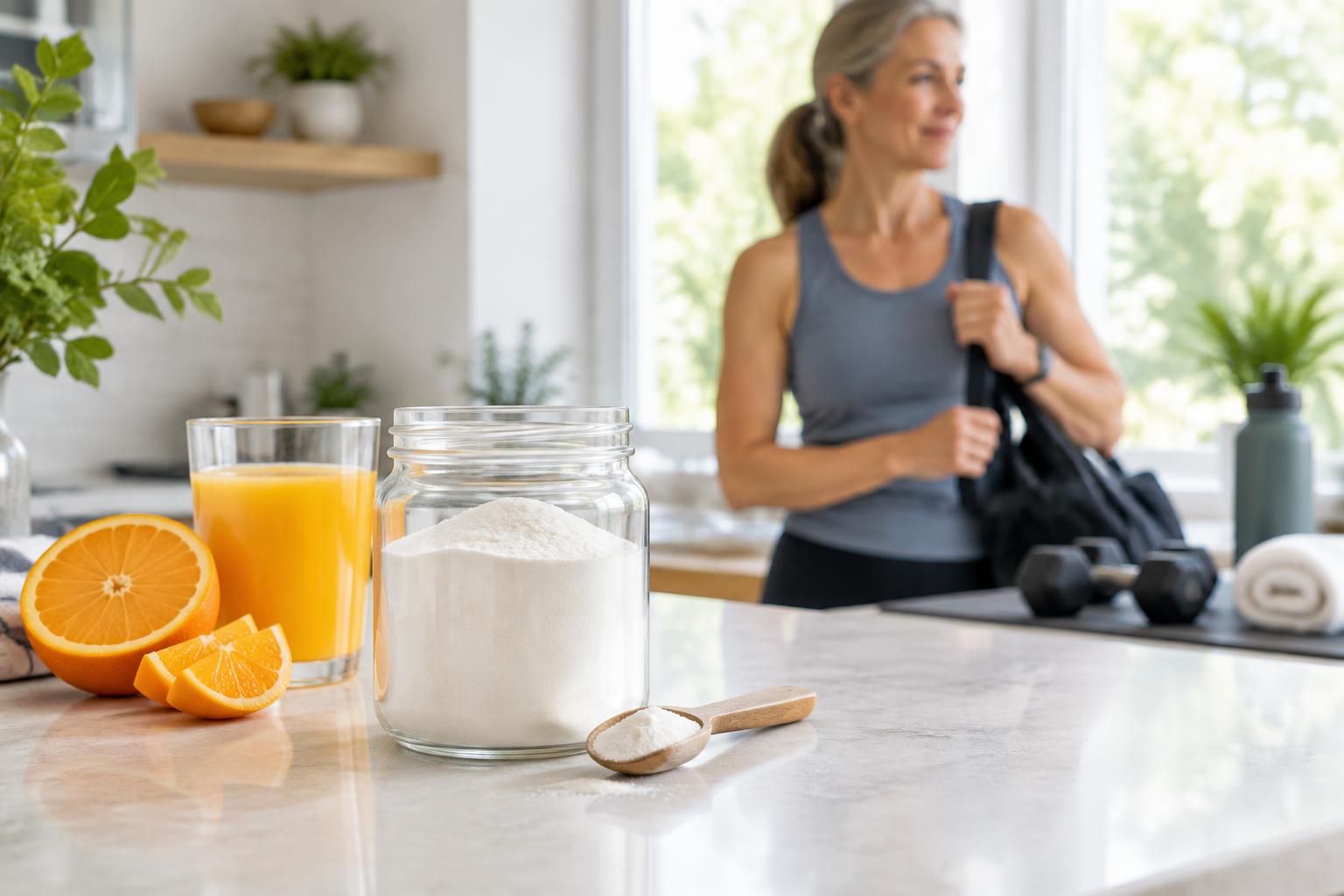
Collagen is everywhere: in coffee creamers, protein bars, and nearly every wellness influencer's morning routine. Some of the hype is earned. Some of it isn't.
I take collagen myself. But as a clinician, I want my supplements to match the evidence, not the marketing. So let's walk through what the research actually supports for active women, where it's still early, and where it falls short.
First, what is collagen?
Collagen is the most abundant protein in your body. It's the structural scaffolding of your tendons, ligaments, cartilage, bone, and skin.
When you swallow a collagen supplement, it doesn't travel to your knees intact. Your gut breaks it down into amino acids (especially glycine, proline, and hydroxyproline) and small peptides. These peak in your bloodstream about an hour after you take it.
Here's the key: those building blocks only get put to work when your tissues are loaded. Exercise is the signal that tells tendon, bone, and cartilage cells to build. Vitamin C is the cofactor they need to do it. That's why timing matters, and why collagen without training is unlikely to do much.
What the evidence supports
✅ Joint comfort with activity
This is collagen's most consistent benefit. Randomized trials in athletes with activity-related knee pain found that 5–10 g per day reduced discomfort during exercise compared with placebo, usually after about 12 weeks. A meta-analysis of osteoarthritis trials also found improvements in stiffness and overall symptom scores.
The effect is modest, not miraculous. But for a woman whose knees ache on long runs or heavy squat days, modest can be meaningful.
✅ Bone density after menopause
This one deserves more attention than it gets. In a year-long randomized trial, postmenopausal women with low bone density took 5 g of specific collagen peptides daily. Their spine and hip bone density increased, while the placebo group's decreased.
It's a single study, and it was funded by the manufacturer, so I hold it loosely. But bone loss accelerates sharply in the years around menopause, and anything with a plausible benefit and minimal risk is worth discussing.
Collagen supports a bone plan. It doesn't replace one. Resistance training, impact exercise, adequate calcium and vitamin D, and a conversation about hormone therapy come first.
Where the evidence is promising but early
🟡 Tendons
Two well-designed trials found that collagen plus 14 weeks of heavy resistance training increased tendon size (Achilles and patellar) more than training alone. A small pilot study in people with Achilles tendinopathy found faster improvement in function when collagen was added to rehab.
The catch: the tendon-size trials included only men, tendon stiffness and strength didn't improve beyond training, and no study has yet shown fewer injuries. Promising, but not proven.
🟡 Strength training results
In a 12-week trial, premenopausal women who took 15 g of collagen while lifting gained more lean mass and grip strength than those on placebo. That's encouraging. But collagen is a poor muscle-building protein on its own, so some of the benefit likely came from simply eating more total protein.
🟡 Muscle soreness
One small study found that collagen taken around hard jump training reduced soreness and helped athletes bounce back faster. It's interesting, but it's one small study in men.
Where it falls short
❌ Skin
This may surprise you. Early studies suggested collagen improved skin hydration and elasticity. But a 2025 meta-analysis of 23 trials found something important: the benefits appeared only in industry-funded and lower-quality studies. In independent, higher-quality trials, the effect disappeared.
The supplement industry has pushed back on that analysis, and the debate isn't over. But for now, I can't honestly tell you collagen will change your skin.
❌ Sleep, hair, nails, and gut health
Collagen is about one-third glycine, and glycine itself has some sleep research behind it. But collagen hasn't been tested for sleep directly. Claims about hair, nails, and "healing your gut" rest on very small or uncontrolled studies.
Why this matters more in midlife
Estrogen helps regulate collagen production in your tendons, ligaments, and skin. As estrogen declines in perimenopause and menopause, collagen synthesis slows, tendons become stiffer and more injury-prone, and bone loss speeds up.
That's exactly when the potential bone and tendon benefits of collagen matter most, and exactly when pairing it with consistent strength and impact training becomes essential.
How I take it
- 10–15 g collagen peptides
- About 50 mg vitamin C (a small glass of orange juice or a supplement works)
- 30–60 minutes before training, so the building blocks peak as my tendons and joints are being loaded
- For at least 3 months before deciding whether it's helping
Choose a third-party tested product (look for NSF Certified for Sport or Informed Sport), especially if you compete.
Can you get collagen from food?
Yes, though it takes more planning. Collagen lives in the parts of animals we often throw away: skin, cartilage, bones, and connective tissue. Good food sources include:
- Bone broth, simmered long enough to gel when chilled
- Gelatin, the same material used in the vitamin C study, which you can make into homemade gummies or stir into warm drinks
- Skin-on chicken and fish, plus tougher, slow-cooked cuts like shank, oxtail, and short ribs
The catch is consistency. The collagen content of broth varies widely from batch to batch, which is why most research uses measured powders.
Your body also makes its own collagen, and it needs the right raw materials to do it. Vitamin C (citrus, berries, peppers, kiwi), zinc (shellfish, meat, pumpkin seeds), and copper (nuts, seeds, legumes) are all cofactors. And all of it starts with eating enough total protein and enough total energy. Under-fueling is one of the fastest ways to undermine tendon, bone, and joint health in active women.
One important reminder
Collagen is not a complete protein. It lacks the amino acid tryptophan and is low in leucine, the key trigger for muscle growth. It doesn't count toward your daily protein goal. Keep prioritizing high-quality protein from food or whey or plant blends: roughly 1.6 g per kilogram of body weight per day for active women.
Who should be cautious
Collagen is one of the safest supplements available. Most people notice nothing beyond mild fullness or an aftertaste. Still, check with your provider first if any of these apply:
- Fish or shellfish allergy: marine collagen is common. Check the source on the label.
- History of kidney stones: some collagen is broken down into oxalate, the main component of the most common type of stone.
- Dietary or religious restrictions: collagen comes from bovine, porcine, fish, or chicken sources. There is no true vegan collagen; "vegan collagen boosters" contain only the cofactors.
- Pregnancy or breastfeeding: there is little research, so food sources are the safer choice.
- Competitive athletes: supplements can be contaminated with banned substances. Stick with third-party certified products.
Supplements should be a thoughtful part of your plan, not the foundation. If you want help building an evidence-based approach for your body and your stage of life, that's exactly what I do at Arete.
References
- Clark KL, et al. 24-week study on the use of collagen hydrolysate as a dietary supplement in athletes with activity-related joint pain. Curr Med Res Opin. 2008.
- Zdzieblik D, et al. Improvement of activity-related knee joint discomfort following supplementation of specific collagen peptides. Appl Physiol Nutr Metab. 2017.
- García-Coronado JM, et al. Effect of collagen supplementation on osteoarthritis symptoms: a meta-analysis of randomized placebo-controlled trials. Int Orthop. 2019.
- König D, et al. Specific collagen peptides improve bone mineral density and bone markers in postmenopausal women: a randomized controlled study. Nutrients. 2018.
- Jerger S, et al. Effects of specific collagen peptide supplementation combined with resistance training on Achilles tendon properties. Scand J Med Sci Sports. 2022.
- Jerger S, et al. Specific collagen peptides increase adaptations of patellar tendon morphology following 14 weeks of high-load resistance training. Eur J Sport Sci. 2023.
- Praet SFE, et al. Oral supplementation of specific collagen peptides combined with calf-strengthening exercises in Achilles tendinopathy. Nutrients. 2019.
- Jendricke P, et al. Specific collagen peptides in combination with resistance training improve body composition and regional muscle strength in premenopausal women. Nutrients. 2019.
- Clifford T, et al. The effects of collagen peptides on muscle damage, inflammation and bone turnover following exercise. Amino Acids. 2019.
- Shaw G, et al. Vitamin C–enriched gelatin supplementation before intermittent activity augments collagen synthesis. Am J Clin Nutr. 2017.
- Myung SK, Park Y. Effects of collagen supplements on skin aging: a systematic review and meta-analysis of randomized controlled trials. Am J Med. 2025.