
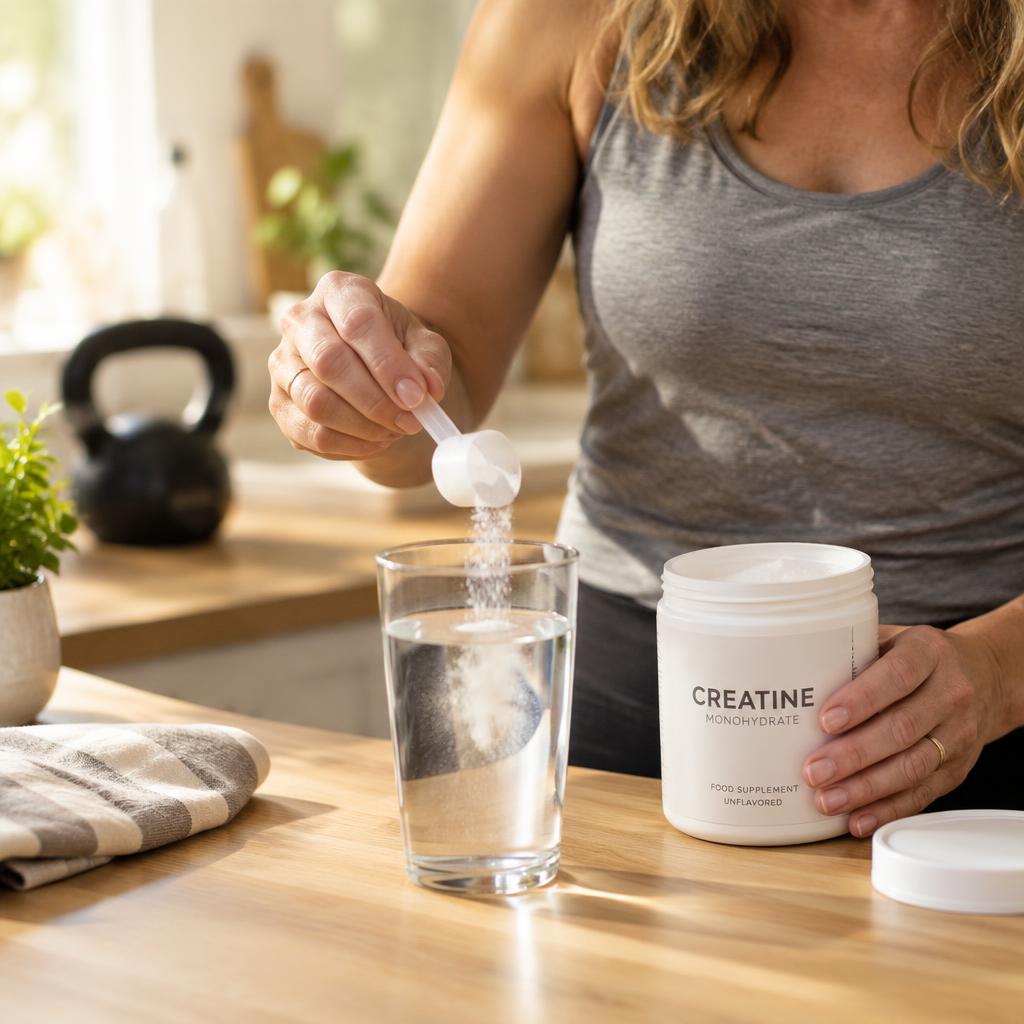
What creatine actually does
Creatine is a naturally occurring compound your body already makes and stores in muscle, the heart, and the brain. It's central to how your cells generate usable energy (ATP) on demand. Think of it as a fast access energy reserve your tissues draw on whenever they're under load, whether that's a flight of stairs, a workout, or a stressed, sleep deprived brain trying to concentrate.
Here's the part most women haven't heard: your body's own creatine production and storage shift across your cycle and across the menopause transition. Estrogen influences the enzyme responsible for creatine production, and women store meaningfully less creatine than men to begin with, while also taking in less through food. That combination means many women are working with a smaller energy reserve right at the life stage when they need it most.
Why perimenopause changes the picture
During perimenopause, fluctuating estrogen doesn't just affect hot flashes and mood. It affects how efficiently your muscles hold onto protein and how much natural creatine your body produces. Research suggests creatine supplementation may actually be more effective during the higher estrogen phase of the cycle, and may help protect muscle protein specifically during the window when hormonal shifts make women more vulnerable to losing it. For women already contending with disrupted sleep, mood changes, and brain fog during this transition, creatine's role in brain energy metabolism is a particularly welcome finding. Supplementation has been studied for supporting cognition, attention, and memory, and for improving mental sharpness specifically during periods of sleep deprivation, which is exactly what perimenopause so often delivers.
Why postmenopause changes it again
After menopause, the priorities shift toward two things every woman should be thinking about: bone and muscle. This is where the research gets especially compelling. In postmenopausal women, creatine has been shown to reduce markers of bone breakdown while increasing bone building cell activity, but only when paired with resistance training. The same pairing effect shows up in muscle: creatine appears to support the biology of muscle repair and growth (including the activity of the very cells responsible for building new muscle tissue), again amplified by strength training. Given that the postmenopausal years are when bone density and lean muscle mass are hardest to hold onto, this combination deserves far more attention than it gets.
One myth worth clearing up here: the water retention and weight gain people associate with creatine is a male specific finding tied to a different dosing approach. The research in women simply doesn't show the same effect. Creatine has been studied in women as a way to build strength and power without those changes in body weight.
Beyond muscle and bone: mood, sleep, and gut health
A few other findings are worth knowing about, even though the research here is earlier stage:
- Mood: Because creatine plays a role in brain energy metabolism, researchers have studied it as an add on to antidepressant treatment in women with major depression, with encouraging results in more than one clinical trial. It's not a replacement for appropriate mental health treatment, but it's a genuinely interesting area of ongoing research specific to women.
- Sleep and stress resilience: Sleep deprivation hits women's cognition and alertness harder than it hits men's, and perimenopause, postpartum, and high stress periods are all named in the research as times when this matters most. Creatine supplementation has been studied as a way to protect mental performance during exactly these stretches.
- Gut integrity: Maintaining the gut's protective lining is energy intensive work, and there's an emerging scientific rationale for creatine's role in supporting that barrier and reducing inflammation, particularly in the context of inflammatory bowel conditions.
The bottom line
Creatine research has, for decades, centered on young male athletes, which means most women have never been told this applies to them at all. But the physiology tells a different story: women store less of it, need it differently across hormonal transitions, and may benefit from it in ways specific to perimenopause and menopause, supporting bone, muscle, brain energy, and mood during a stretch of life when all four are under real pressure.
As always, talk with your provider about whether creatine supplementation is a good fit for your specific health picture.
This post is for educational purposes and isn't a substitute for personalized medical advice.
Selected references
- Smith-Ryan AE, Cabre HE, Eckerson JM, Candow DG. Creatine Supplementation in Women's Health: A Lifespan Perspective. Nutrients. 2021;13(3):877.
- Wyss M, Kaddurah-Daouk R. Creatine and Creatinine Metabolism. Physiol Rev. 2000;80(3):1107-1213.
- Allen PJ. Creatine metabolism and psychiatric disorders: Does creatine supplementation have therapeutic value? Neurosci Biobehav Rev. 2012;36(5):1442-1462.
- Lyoo IK, Yoon S, Kim TS, et al. A randomized, double-blind placebo-controlled trial of oral creatine monohydrate augmentation for enhanced response to an SSRI in women with major depressive disorder. Am J Psychiatry. 2012;169(9):937-945.
- Yoon S, Kim JE, Hwang J, Kim TS, et al. Effects of Creatine Monohydrate Augmentation on Brain Metabolic and Network Outcome Measures in Women with Major Depressive Disorder. Biol Psychiatry. 2016;8(6):439-447.
- Nemets B, Levine J. A pilot dose finding clinical trial of creatine monohydrate augmentation to antidepressant treatment in major depression. Int Clin Psychopharmacol. 2013;28(3):127-133.
- Wallimann T, Hall CHT, Colgan SP, Glover LE. Creatine Supplementation for Patients with Inflammatory Bowel Diseases: A Scientific Rationale for a Clinical Trial. Nutrients. 2021;13(5):1429.
Written by Michelle Mullins, AGACNP-BC, FNP-BC